
Where Teleox Compresses the Stack
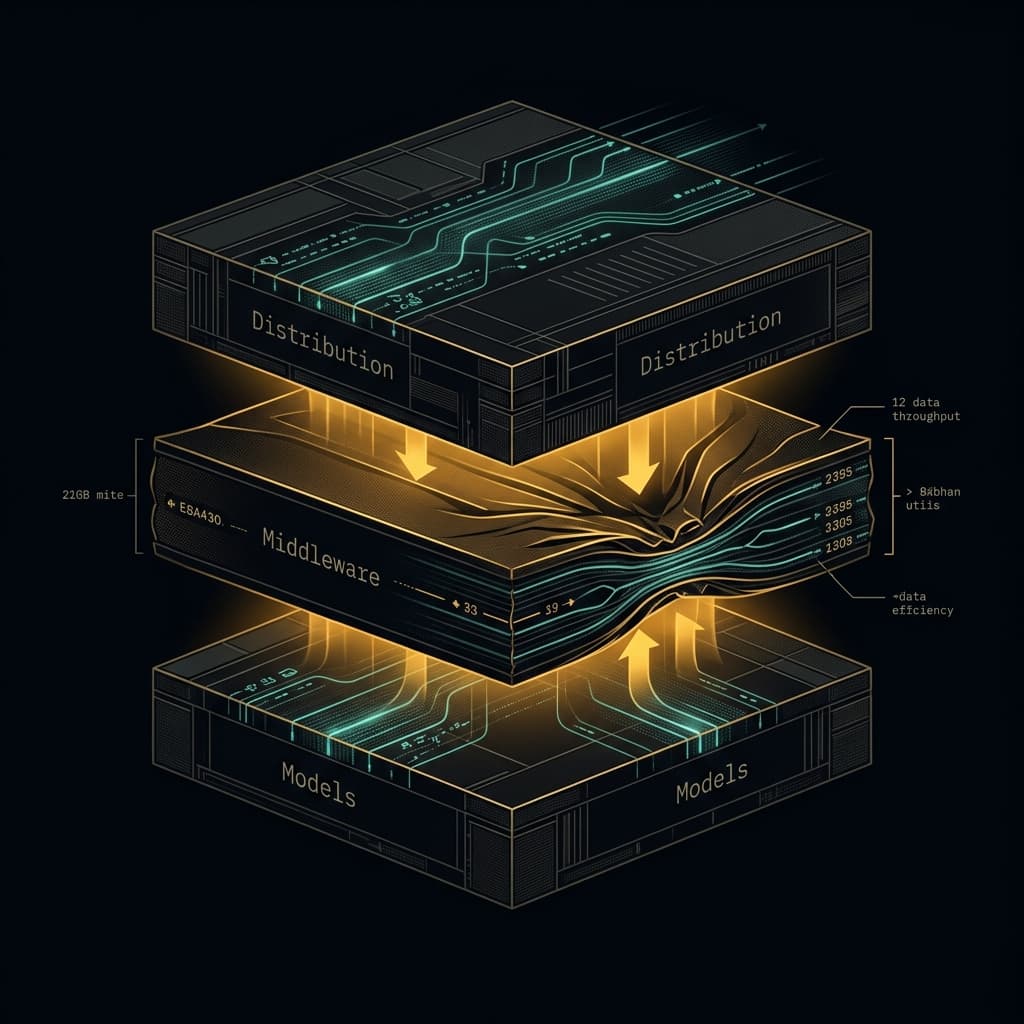
Six weeks ago, I read a piece — “Middleware: durable position or renting space?”— that diagnosed the current AI-stack structure with more precision than any investor memo I've seen this year. The author's framing was simple: when a technology stack consolidates, the layer between the platform owner and the customer is the layer that gets squeezed.
That piece was written before OpenAI shipped Frontieron February 5, 2026. Frontier matters because it ends the strategic ambiguity that was holding the middleware valuations up. The model makers are now platform makers. The distance between “we use GPT-4 as an API” and “we are competing with OpenAI for the enterprise relationship” is measured in product releases, not fiscal quarters.
Teleox.ai is the piece of technology that hands those capabilities back to the hyperscalers. We did not build Teleox to collapse the middleware — Chris Royse built it because the data wall, the alignment problem, and the verification gap were the three hardest blockers to frontier-scale AI, and solving them produced a stack that does the middleware companies' work as a byproduct.
This paper is my attempt to describe, as precisely as I can from publicly verified sources as of April 2026, which categories absorb first, which companies are structurally exposed, why the math works the way it does, and what the frontier labs unlock by moving first.
The five largest hyperscalers are on track for $660–690 billion of capital expenditure in 2026 — nearly double their 2025 spend. Amazon alone announced $200B. Alphabet guided $175–185B; Meta $115–135B; Microsoft $120B+.
Against that capex, AI-services revenue delivered approximately $25 billion in 2025 — roughly ten percent of the infrastructure being built. Every hyperscaler is now structurally compelled to own as many downstream token-generating layers as physics and competition law permit.

On February 5, 2026, OpenAI shipped Frontier — an enterprise platform that pairs Forward Deployed Engineers with enterprise teams, builds a shared semantic context layer across CRMs and internal systems, and ships evaluation loops for agents.
Its six launch partners — Abridge, Clay, Ambience, Decagon, Harvey, Sierra— were, twelve months earlier, pitching domain-context moats as the reason a hyperscaler couldn't absorb them. Every one of them is now committed to running on OpenAI's platform.
This is the context in which a Teleox-class technology lands. Frontier is the platform; Teleox is the capability stack that lets the platform absorb categories Frontier cannot reach on its own.
Each category below has a genuine capability the hyperscaler lacks today. Teleox is the technology that closes each gap. The ordering is roughly fastest-to-slowest on the absorption clock.

Teleological Constellation Training decomposes a fixed corpus through 9+ frozen embedders (scaling to 50+), producing 100x+ labeled training signal per datum with no synthetic tokens and no Shumailov-collapse dynamic.
Meaning compression is the fourth compression category — after bit, weight, and activation. The seat is unoccupied. Teleox sits in it.
LoRAs that force deterministic outputs — a three-layer enforcement stack: learned LoRA + constrained logit decoder (arithmetic, cannot be jailbroken) + 13-embedder constellation guard.
The model is structurally incapable of acting outside intent. Per-output cosine verification with human-readable rejection reasons, every output.
| PROPERTY | SCALAR REWARD (RLHF/DPO) | TCT (GEOMETRIC) |
|---|---|---|
| Target | Learned preference model (proxy that drifts) | Frozen centroid (direct definition) |
| Drift | Possible (reward hacking) | Bounded by acceptance threshold |
| Verifiability | Indirect — statistical | Direct — per-output cosine, every output |
| Per-output guarantee | None | Boolean accept/reject + reason |
| Failure mode | Goodharting, mode collapse | Frame rejection, regeneration |
Total pool ceiling: ~$600B–$1T by 2030–2032. These are ceilings, not commitments. Combined audience-level unlock adds $300–700B. Total all-audience pool: $1T–$1.7T.
| # | MARKET | 2030–2034 SIZE |
|---|---|---|
| 1 | Regulated-enterprise AI deployment | $150–400B |
| 2 | Clinical AI governance / FDA-path LLMs | $71.1B by 2036 |
| 3 | Legal AI at citation-grade | $20–50B by 2032 |
| 4 | Voice AI contact-centre at compliance grade | $47.5B by 2034 |
| 5 | Agentic AI in regulated verticals | $52–139B |
| 6 | 13-embedder RAG / Retrieval 2.0 | $9.86B → $64.5B by 2035 |
| 7 | Training-signal-as-an-asset-class | $10–50B (new) |
| 8 | Sovereign AI native-language stacks | $100–300B lifetime |
| 9 | Verification-grade synthetic media | $10–40B |
| 10 | Enterprise brand-voice products | $5–20B ARR |
| 11 | Post-training-as-a-service (TCT LoRAs) | $10–30B ARR |
| 12 | Training-cost structural avoidance | $50–100B EV uplift |
Pillar 1 — Meaning Extraction (TCT). A meaning-extraction stack that decomposes a fixed corpus through 9+ frozen embedders (scaling to 50+), producing 100x+ labeled training signal per datum with no synthetic tokens and no Shumailov-collapse dynamic. The headline is meaning, not volume.
Pillar 2 — Deterministic Outputs (LoRAs). A three-layer enforcement stack — learned LoRA + constrained logit decoder (arithmetic, cannot be jailbroken) + 13-embedder constellation guard. The model is structurally incapable of acting outside intent.
Measured proof, not promises. Voice cloning Case 3: 0.961 mean WavLM SECS, +0.080 over VALL-E 2 human parity. Shakespeare injection-resistant. Three-tier evidence structure — measured, architecturally complete, constructive — strictly preserved in every external conversation.
“Everything else is renting. And the landlords are getting hungrier.”