text-dda-witness
Context Graph
Text-side DDA witness using 13 frozen embedders, RocksDB storage, and MCP retrieval tools.
- Embedder panel
- N=13
- Structured signals
- up to 91 per input
Independent research
DDA projects real data through frozen embedder panels. TCT reuses those panels as labellers, training targets, and runtime guards.
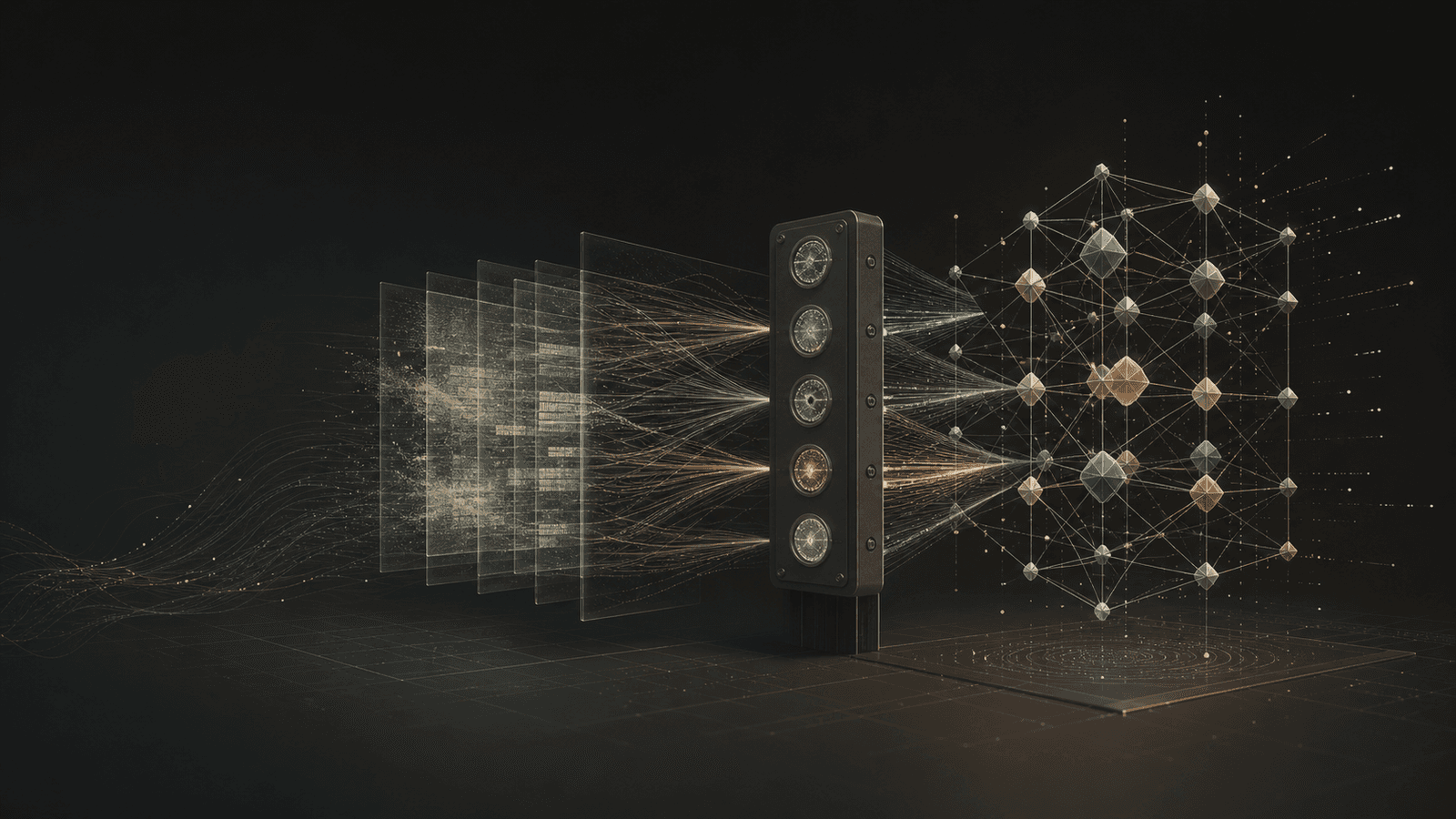
signals <= n * (N + choose(N, 2))Figure 1.DDA holds real data fixed and decomposes it into structured supervision through frozen instruments.
The visual shows translucent source-data slabs feeding into a frozen multi-embedder panel. Output beams from the panel form a structured geometric lattice on the right, representing typed signals and relationships derived from fixed real observations.
The data wall is not only a raw-token shortage. It is also a structured-signal shortage: a single token stream exposes only one view of the structure inside real observations.
DDA keeps the raw corpus fixed and projects it through frozen embedders. This keeps the source observations real while adding typed labels and pairwise features that can be inspected.
For n inputs and N frozen embedders, the derived signal count is bounded by the per-embedder projections plus the embedder-pair interactions.
The pairwise term is a constructive upper bound. Effective signal count depends on measured redundancy, so the mutual-information audit remains explicit future work.
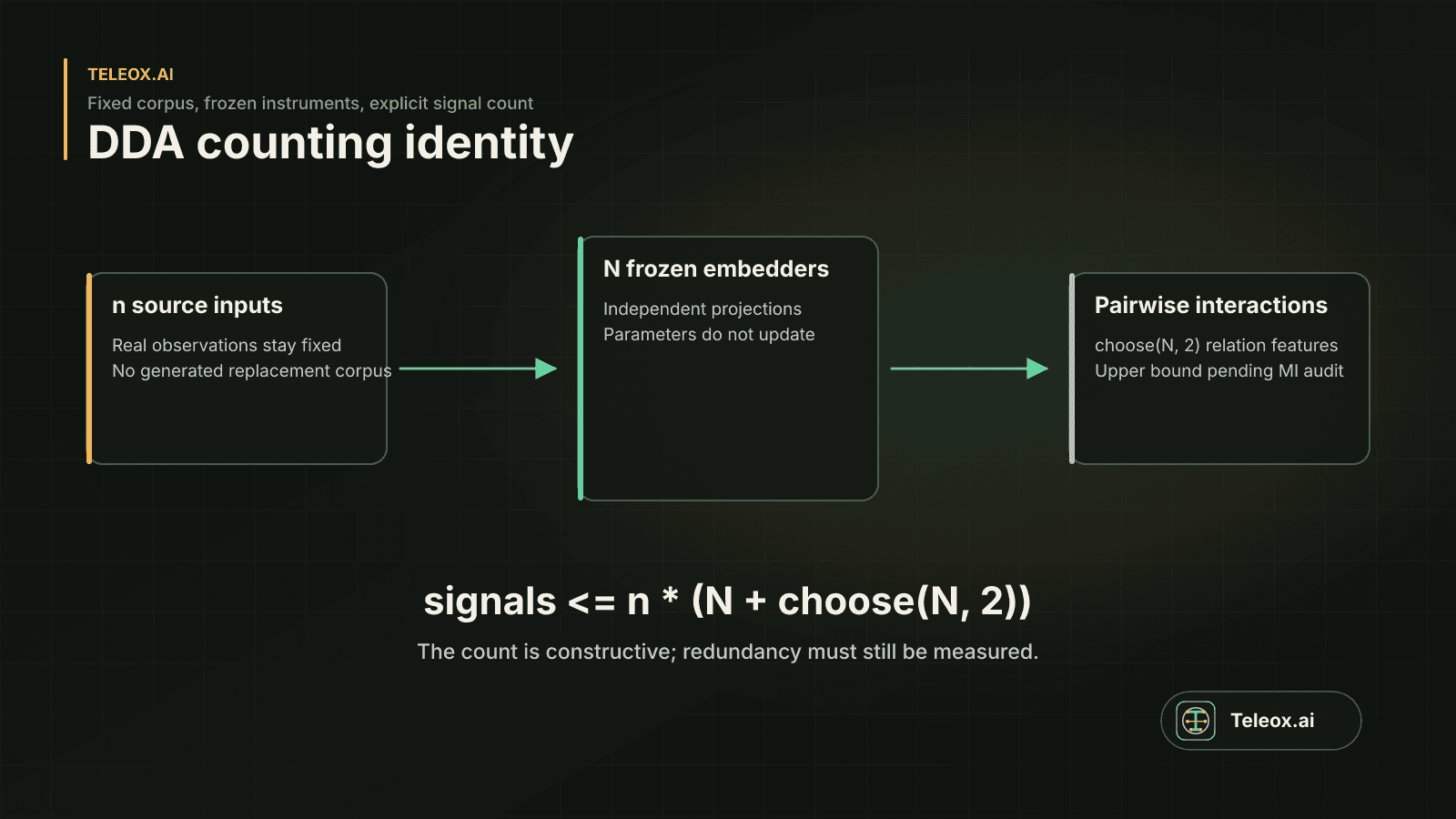
Figure 2.The DDA identity counts per-embedder projections plus pairwise interaction features.
The diagram starts with n raw inputs. Each input is passed through N frozen embedders, producing N direct projections. Pairwise interaction features are then computed for every embedder pair, producing choose(N, 2) additional structured signals per input. The displayed identity is signals less than or equal to n * (N + choose(N, 2)); the pairwise term is a constructive upper bound pending mutual-information audit.
Meaning compression is the ratio view of DDA: structured signals per raw-data unit.
TCT then uses the same frozen panel to construct centroids, train against those centroids, and accept or reject candidate outputs with a panel-relative geometric guard.
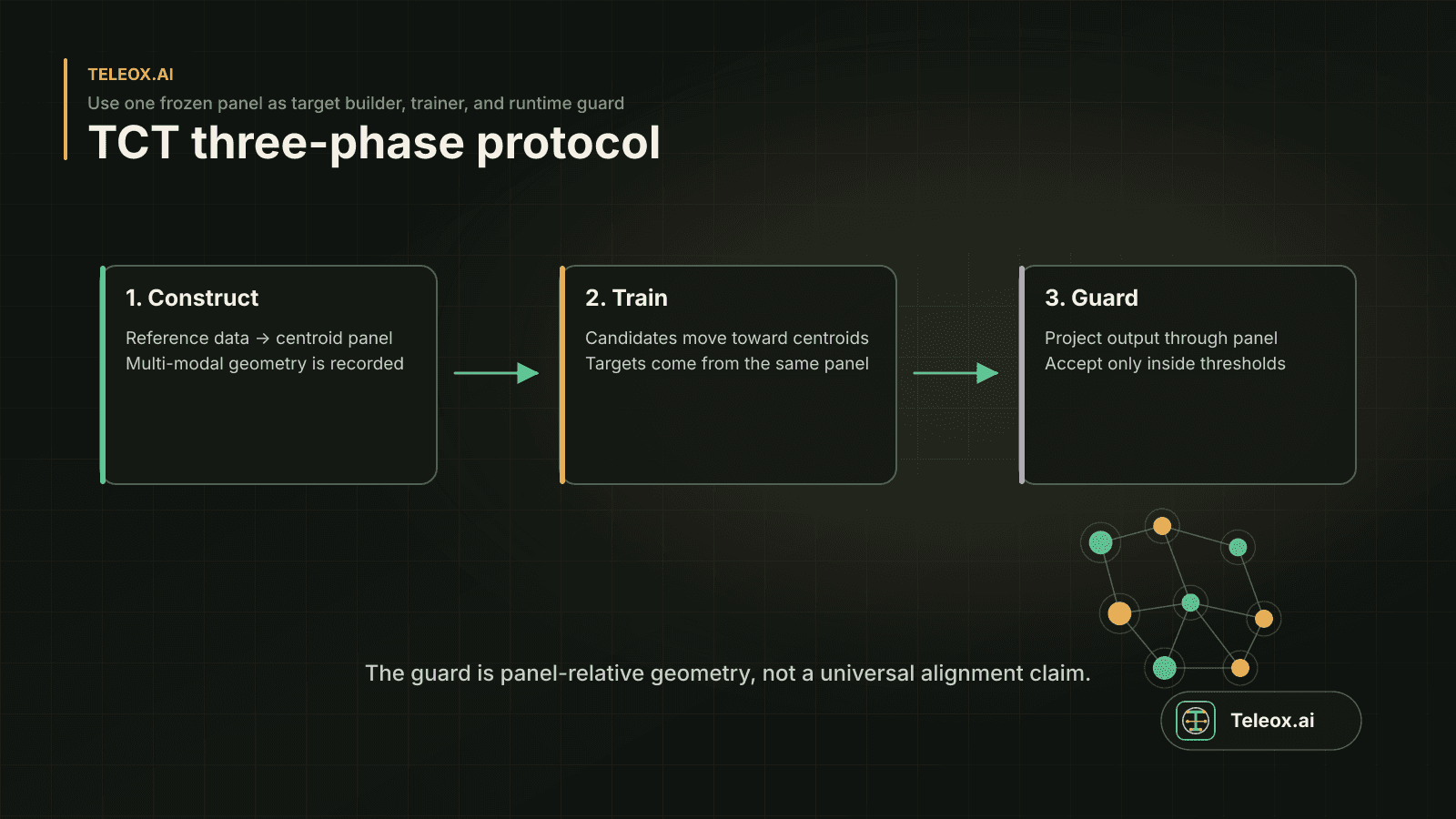
Figure 3.TCT reuses the frozen panel as target construction, training target, and runtime guard.
The figure shows TCT as three phases. Phase 1 constructs frozen multi-modal centroids from reference data. Phase 2 trains generated outputs against those centroid targets. Phase 3 evaluates candidate outputs with a deterministic geometric guard. The guard only verifies proximity to the chosen centroid panel.
Context Graph, ClipCannon, OCR Provenance, and Dynamic / ME-JEPA are evidence surfaces around the same posture: real source data, durable records, and independent verification.
text-dda-witness
Text-side DDA witness using 13 frozen embedders, RocksDB storage, and MCP retrieval tools.
video-dda-witness
Video-side DDA/TCT witness using a 23-stage DAG, seven modalities, and per-project provenance records.
document-provenance-witness
Document-side provenance witness for local-first OCR, chunking, embeddings, and hash-linked records.
jepa-runtime-witness
Private-preview JEPA-style runtime witness for audited bundles, deterministic artifacts, and Full State Verification.
The paper library separates framework preprints, system whitepapers, measured case studies, and background theory so that each claim stays near its source and limitation.
00:11:23 / 6umU6kuXR3s
Plain-language talk track for the fixed-data DDA move and the meaning-compression ratio.
The formal site claim is narrower than the talk title: DDA is fixed-corpus decomposition and meaning compression is a proposed structured-signal-density measure.
Open video pagepreprint / April 2026
Primary framework preprint for DDA, meaning compression, TCT, and panel-relative generation guards.
DOI 10.13140/RG.2.2.24370.57288
preprint / April 2026
DDA explainer preprint for fixed-corpus decomposition through frozen embedder panels.
DOI 10.13140/RG.2.2.22624.03845
preprint / March 2026
Measured voice case: 0.961 mean WavLM SECS under an encoder-matched one-speaker protocol with held-out English sentences.
DOI 10.13140/RG.2.2.33842.16324
00:11:23 / 6umU6kuXR3s
Plain-language talk track for the fixed-data DDA move and the meaning-compression ratio.
The formal site claim is narrower than the talk title: DDA is fixed-corpus decomposition and meaning compression is a proposed structured-signal-density measure.