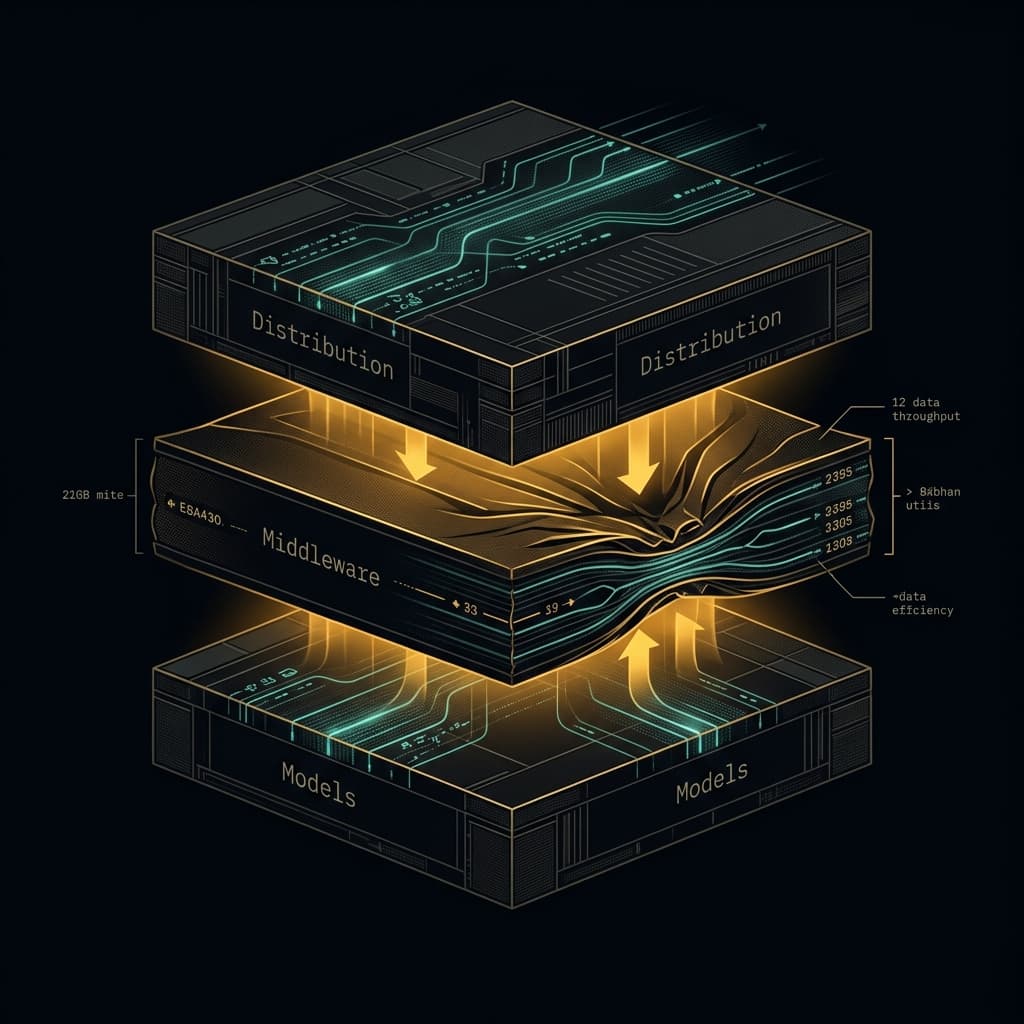
Scale AI sold its neutrality. The post-training stack is open.
Meta’s 49% converted the industry’s neutral post-training supplier into a competitor-owned asset. Every other frontier lab now needs a post-Scale path — and the substrate Scale was priced against is the substrate TCT replaces.
Four Sentences
- Meta acquired 49% of Scale AI for $14.3B in 2024, at a peak valuation around $29B — converting the industry’s neutral post-training supplier into an asset whose marginal value accrues to one specific lab.
- Every other frontier lab (OpenAI, Anthropic, Google, xAI) cannot continue to route labelers, preference pairs, evaluation data, and RLHF recipes through a vendor half-owned by a direct competitor — so the post-training substrate is structurally open for the first time since 2021.
- Scalar-reward post-training (RLHF / DPO / Constitutional) is a learned preference model that drifts; geometric post-training against a frozen constellation centroid is a per-output boolean accept/reject against a direct definition of identity, style, and safety — structurally different and better aligned.
- Teleox.ai is not owned by any lab, ships meaning extraction that replaces human labeling, and ships deterministic LoRAs that replace reward-model training — the same seat Scale vacated, at 100–1000× the production efficiency of the human-labour curve.
The price of picking a side
In June 2024, Meta announced a $14.3B investment for 49% of Scale AI and hired Scale’s CEO into a senior AI leadership role. Public reporting around the transaction pegged Scale’s pre-deal valuation at roughly $29Band Scale’s 2024 revenue at approximately $1B+. [1][2]
What was being priced at $29B was not the annotator network on its own. It was the annotator network multiplied by Scale’s position as the neutral post-training supplier to every frontier lab at once. OpenAI, Anthropic, Google, and xAI all ran RLHF preference-pair and expert-labeled dataset pipelines through Scale. The picks-and-shovels premium was the multiplier.
A 49% stake from any single frontier-lab owner collapses that multiplier. You can still buy the labor. You cannot buy the neutrality once the neutrality has been sold.
Every other lab now needs a post-Scale path
The economic question any non-Meta lab now faces is simple: do I continue to share my labelers, my preference pairs, my evaluation data, and my RLHF recipes with a supplier whose economics accrue in part to a direct competitor?
Public reporting in the months after the deal documented labs reducing Scale dependency. OpenAI was reported by The Informationto be moving post-training workloads away from Scale. [3] Bloomberg and other outlets reported similar patterns at Google and xAI. [4] Anthropic’s situation is distinctive: their alignment posture is public, their $1.5B publisher-settlement exposureraised the bar for IP-clean, provenance-auditable training data industry-wide [8], and their training-data supply chain now has to answer two questions simultaneously — “is this provenance clean?” and “is this supplier neutral?”
Meanwhile the sector is already pivoting. Surge AI (~$1.2B revenue 2024, bootstrapped, profitable) [5] and Mercor ($10B valuation on a vetted-expert network) [6] have absorbed much of the workflow Scale used to anchor. Both are human-labour companies; both inherit the same ceiling.
The exodus from Scale is not the story. The story is that the substratethe entire category was priced against — human annotator supply, priced by the hour — is now simultaneously (a) politically compromised at its market leader, and (b) about to be out-scaled by a different substrate entirely.
Three Post-Training Substrates
There are three ways to produce post-training signal at scale today. Only one of them survives the combination of Scale’s neutrality loss and the Shumailov model-collapse dynamic.
| SUBSTRATE | EXAMPLES | CEILING | LAB NEUTRALITY | COLLAPSE RISK | POST-SCALE VIABILITY |
|---|---|---|---|---|---|
| Human labelers | Scale AI, Surge AI, Mercor, Labelbox | Global annotator supply. Linear cost-per-signal. | Depends on ownership. Broken when a lab acquires the supplier. | None (human data). | Viable only for problem classes TCT does not cover — open-ended preference, domain-expert evaluation. |
| Synthetic generation | Model-generated training pairs, self-play, self-distillation at scale | Shumailov et al. — model-collapse dynamic. Quality degrades per generation. | Lab-internal. No third-party substrate. | High. The published failure mode of the approach. | Useful as augmentation, not as a scaling substrate. |
| Meaning extraction (multi-embedder decomposition) | Teleox.ai — TCT through 13 frozen embedders | Embedder diversity. Scales with compute, not annotators. | Infrastructure layer. Teleox is not owned by any lab; can serve every lab simultaneously. | None — no synthetic tokens, no feedback loop. | The post-Scale path. 100x+ labeled signal per datum, no human annotators. |
Shumailov et al. (2023): synthetic-on-synthetic training produces progressive distributional drift — the published failure mode for substrate (2). [7]
Equity Comparables
What $29B actually priced, against a peer set on the same human-labour curve.
| COMPANY | VALUATION | NOTES | SUBSTRATE |
|---|---|---|---|
| Scale AI | $29B peak | Meta acquired 49% for $14.3B (2024). ~$1B+ revenue 2024. | Human labor |
| Surge AI | Pre-IPO | ~$1.2B revenue 2024. Bootstrapped, profitable, specialist RLHF. | Human labor |
| Mercor | $10B | Vetted-expert network; priced on continued expert-labour scaling. | Human talent |
| Labelbox / Snorkel / Appen | Consolidating | Long-tail absorbed/declined base case. | Human labor + tooling |
| Teleox.ai | Pre-revenue | Two-pillar infrastructure. Not owned by any lab. | 13-embedder constellation + deterministic LoRAs |
Scalar Reward vs. Geometric Constraint
RLHF, DPO, and Constitutional AI all train against a learned proxyof the thing you want. TCT trains against the thing itself — a frozen L2-normalised centroid computed once from a reference corpus. Every generated output is re-embedded and compared by cosine similarity; anything off the manifold is rejected with a human-readable reason. This is the load-bearing difference.
| PROPERTY | SCALAR REWARD (RLHF / DPO / CONSTITUTIONAL) | TCT (GEOMETRIC CONSTRAINT) |
|---|---|---|
| Target | Learned preference model (proxy that drifts) | Frozen centroid (direct definition of identity / style / safety) |
| Drift | Possible — reward hacking, reward-model distribution shift | Bounded by cosine acceptance threshold |
| Verifiability | Indirect — statistical across many samples | Direct — per-output cosine similarity, every output |
| Human feedback required | Ongoing — needed continuously to refresh the reward model | One-time — centroid construction only |
| Failure mode | Goodharting, mode collapse toward reward-gaming | Frame rejection, regeneration |
| Per-output guarantee | None | Boolean accept / reject + human-readable rejection reason |
| Vendor neutrality | Labeler networks shared across labs — neutrality depends on ownership | Infrastructure layer — runs inside the lab, data never leaves |
| Scaling substrate | Human annotator supply (physical labour curve) | Embedder diversity (13+, scaling to 50+) — compute curve |
Source: TELEOX_PROOF_PACK.md§2 — Pillar 2 scalar-vs-geometric formal table.
One Stack. Two Pillars. Post-Scale Post-Training.
Replaces the human labeler. TCT decomposes a fixed corpus through 13 frozen embedders (9+ in pipeline, scaling to 50+), producing 100x+ labeled training signal per datumwith meaning labeled across dimension spaces — no synthetic tokens, no Shumailov-collapse dynamic.
The headline is meaning, not volume. Volume is the how, not the what.
Replaces reward-model training. A three-layer enforcement stack: learned LoRA + constrained logit decoder (arithmetic, cannot be jailbroken) + 13-embedder constellation guard against a frozen centroid.
The model is structurally incapable of acting outside intent. Per-output cosine verification with human-readable rejection reasons, every output.
Training-Signal-as-an-Asset-Class
A new asset class opens when the post-training substrate is available as infrastructurerather than labour. This is the market Scale’s $29B was priced against on the assumption of a human-labour ceiling. Remove the ceiling, and the category reprices.
| MARKET POOL | CEILING (2030–2034) |
|---|---|
| Training-signal-as-an-asset-class | $10–50B (new category) |
| Post-training-as-a-service (TCT LoRAs) | $10–30B ARR |
| Training-cost structural avoidance (hyperscaler EV uplift) | $50–100B EV |
| Regulated-enterprise AI deployment | $150–400B |
| Sovereign AI native-language stacks | $100–300B lifetime |
| Agentic AI in regulated verticals | $52–139B |
Total frontier-lab unlock pool: ~$600B–$1T by 2030–2032(Part A of TELEOX_MODEL_MAKER_VALUE_CREATION.md). These are ceilings, not commitments. The point of the frame is that the arithmetic of post-training economics changes once the substrate stops being priced by the hour.
A note for the RLHF lineage
If you built a frontier lab through the RLHF lineage — Christiano, Ouyang, the Anthropic HH paper, Constitutional AI, DPO — you have spent the last six years shipping the best available version of a scalar-reward post-training stack. The stack works. It also drifts, it Goodharts, and it demands continuous human feedback that is now structurally compromised at the market leader.
Teleox does not ask you to throw that work away. It asks you to add a geometric constraint on top of it. Train against a frozen constellation centroid. Verify every output against the manifold. Keep the reward model for problems it solves well; let the geometric layer handle identity, style, and safety — the problems with measurable attributes.
Teleox.ai is not owned by any lab.It can serve every lab simultaneously — the same structural position Scale held before Meta. The post-training stack you rebuild today can be the stack every regulated-AI market routes through for the next decade, with you as the lab that shipped it first.
The 48-hour POC runs on a data slice you choose. You keep the outputs either way.
— for the Tom Brown / Anthropic lineage and every lab now weighing the same question
“Scale ships labor. Teleox ships meaning + determinism.”
Sources (Exa-verified, April 2026)
- CNBC — Meta announces $14.3B investment in Scale AI (June 2024) — https://www.cnbc.com/2024/06/13/meta-announces-14point3-billion-investment-in-scale-ai-hires-ceo-alexandr-wang.html
- Reuters — Meta takes 49% stake in Scale AI — https://www.reuters.com/technology/artificial-intelligence/meta-invest-149-billion-scale-ai-hire-ceo-information-reports-2024-06-10/
- The Information — OpenAI moving away from Scale post-Meta deal — https://www.theinformation.com/articles/openai-scale-ai-meta
- Bloomberg — Google, xAI reducing Scale dependency after Meta stake — https://www.bloomberg.com/news/articles/2024-06-scale-ai-customers
- Surge AI public revenue figures (2024, ~$1.2B) — https://surge-ai.com
- Mercor $10B valuation — The Information / Bloomberg — https://www.theinformation.com/articles/mercor-valuation
- Shumailov et al. — “The Curse of Recursion” (model-collapse paper) — https://arxiv.org/abs/2305.17493
- Anthropic $1.5B publisher copyright settlement (2025) — https://www.reuters.com/legal/litigation/anthropic-copyright-settlement
- TELEOX_PROOF_PACK.md — 0.961 WavLM SECS, 12,000+ samples, injection-resistant, 100x+ labeled training signal per text input — https://teleox.ai/proof
- TELEOX_MODEL_MAKER_VALUE_CREATION.md — Part A frontier labs unlock pool — https://teleox.ai/for-labs
All Teleox capability claims trace to TELEOX_PROOF_PACK.md. Market / company figures are Exa-verified as of April 2026. Deal-terms language (Meta 49% / $14.3B) reflects the public record at time of writing; the thesis holds regardless of subsequent ownership changes, because the neutrality bit flipped at the moment the transaction was announced and has not been unflipped.