Research library
Limitations are part of the evidence surface.
The site keeps upper bounds, measured results, protocol rows, and withheld artifacts visible instead of burying them.
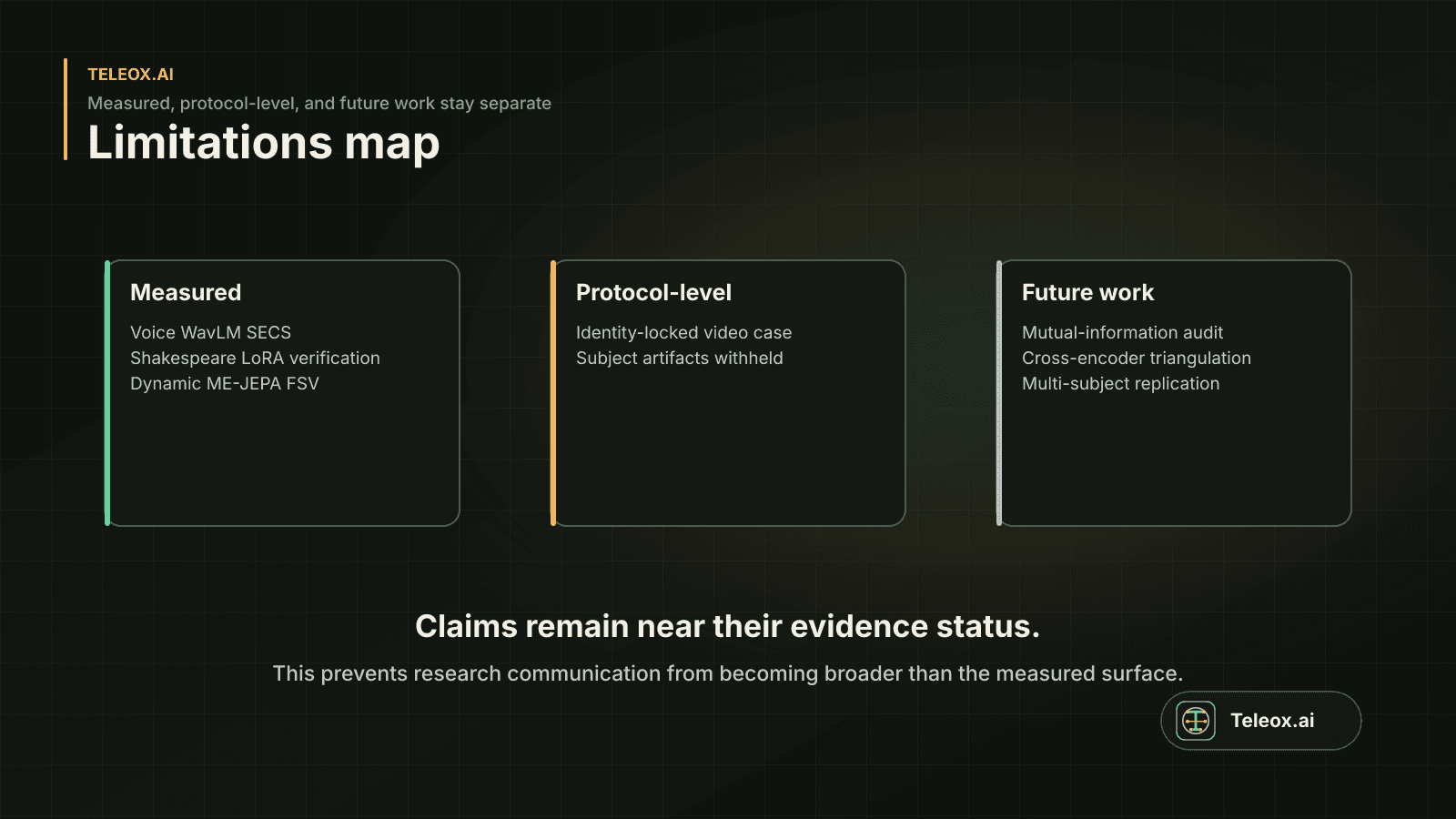
Figure 1.Limitations are part of the evidence surface: measured, protocol-level, and future-work rows stay separate.
Figure description
The map groups claims by evidence status. Measured rows include the voice WavLM SECS case, Shakespeare LoRA verification, and Dynamic ME-JEPA private-preview verification. Protocol-level rows include the identity-locked video case. Future-work rows include mutual-information audit, cross-encoder triangulation, multi-subject replication, and cross-language expansion.
DDA upper-bound tightness
The DDA counting identity is a constructive upper bound. The effective count must be reduced by observed redundancy and task relevance once mutual information is measured.
Voice protocol scope
The voice case reports 0.961 mean WavLM SECS on 10 held-out English sentences for one speaker under an encoder-matched protocol. It is not a cross-encoder identity proof.
Subject-data withholding
Identity-sensitive cases are intentionally asymmetric: methods and scoped metrics can be described while subject-specific audio, video, and clone artifacts remain withheld.
Open measurements
Open work includes pairwise mutual-information audit, ECAPA-TDNN cross-encoder triangulation, multi-subject replication, cross-language expansion, and end-to-end measurement for the identity-locked video case.
Sources
- docs/refactorwebsite/11_claims_risk_and_scope_guards.md
- docs2/PAPER.md#8