primary
Derived Data Abundance
DDA decomposes fixed real data through frozen embedder panels into structured supervisory signals.
Framework
The same frozen panel can retrieve, label fixed data, define targets, and guard generated outputs without updating its parameters.
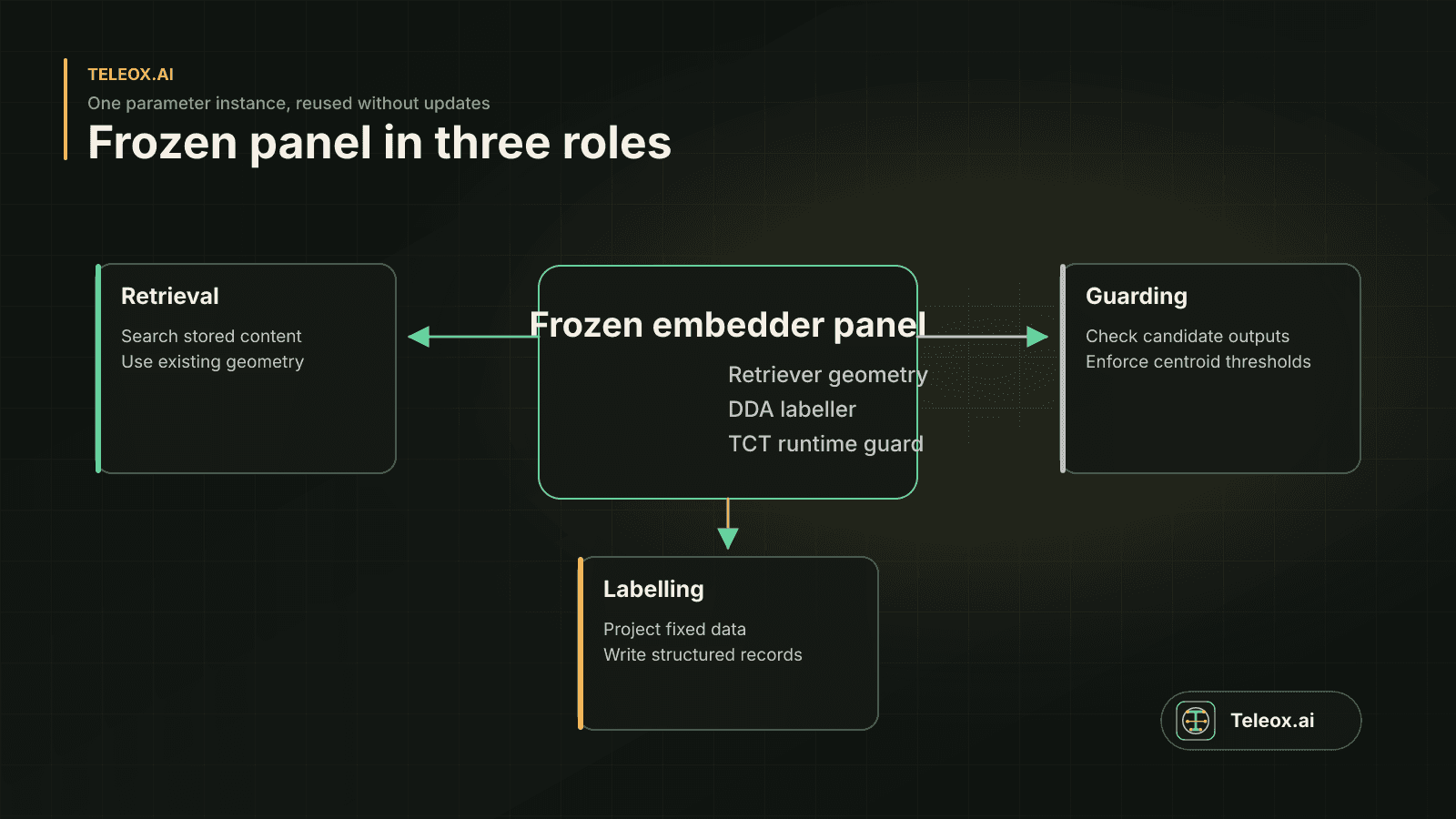
Figure 1.One frozen panel supplies retrieval geometry, DDA labels, and TCT guard checks.
The figure places one frozen embedder panel at the center. Three arrows connect it to retrieval over stored content, DDA labelling over fixed source data, and TCT runtime guard evaluation over generated candidates. The point is that the same parameter instances are reused without updates across all three roles.
DDA starts from real observations and frozen instruments. The derived dataset attaches per-embedder projections and pairwise interactions to source inputs instead of replacing them.
primary
DDA decomposes fixed real data through frozen embedder panels into structured supervisory signals.
Meaning compression asks how many structured labels are measured per raw-data unit. It is complementary to bit, weight, and activation compression.
primary
Meaning compression is the ratio view of DDA: structured signal density per unit of raw data.
TCT builds a centroid panel, trains candidates toward that panel, and checks generated outputs with a deterministic geometric predicate relative to the chosen centroid panel.
primary
TCT constructs frozen multi-modal centroids, trains against them, and verifies candidates with a geometric runtime guard.
It is not synthetic data branding. It is not a universal alignment claim. It is not a benchmark claim against RLHF, DPO, or Constitutional AI. It is a source-grounded way to measure and reuse structure in fixed data.
Context Graph implements the text-side witness. ClipCannon implements the video-side witness. OCR Provenance and Dynamic / ME-JEPA show the broader source-of-truth verification posture.
text-dda-witness
Text-side DDA witness using 13 frozen embedders, RocksDB storage, and MCP retrieval tools.
video-dda-witness
Video-side DDA/TCT witness using a 23-stage DAG, seven modalities, and per-project provenance records.
document-provenance-witness
Document-side provenance witness for local-first OCR, chunking, embeddings, and hash-linked records.
jepa-runtime-witness
Private-preview JEPA-style runtime witness for audited bundles, deterministic artifacts, and Full State Verification.
00:11:23 / 6umU6kuXR3s
Plain-language talk track for the fixed-data DDA move and the meaning-compression ratio.
The formal site claim is narrower than the talk title: DDA is fixed-corpus decomposition and meaning compression is a proposed structured-signal-density measure.